
Three Days to See
Emergency Glasses for Disaster Scenarios
The Problem
I have 575-degree myopia. Losing my glasses in a familiar room is already disorienting — let alone in rubble, smoke, or darkness.
↑ my world without glasses
live with myopia worldwide
golden rescue window before survival rate collapses
standard disaster kits include vision correction
Myopia glasses are not provided
as emergency supplies —
anywhere.
Research
Difficulty without Eyeglasses in Normal Life
We interviewed a nearsighted classmate, who one day had her glasses broken. With her vision blurred, she experienced a completely different world.
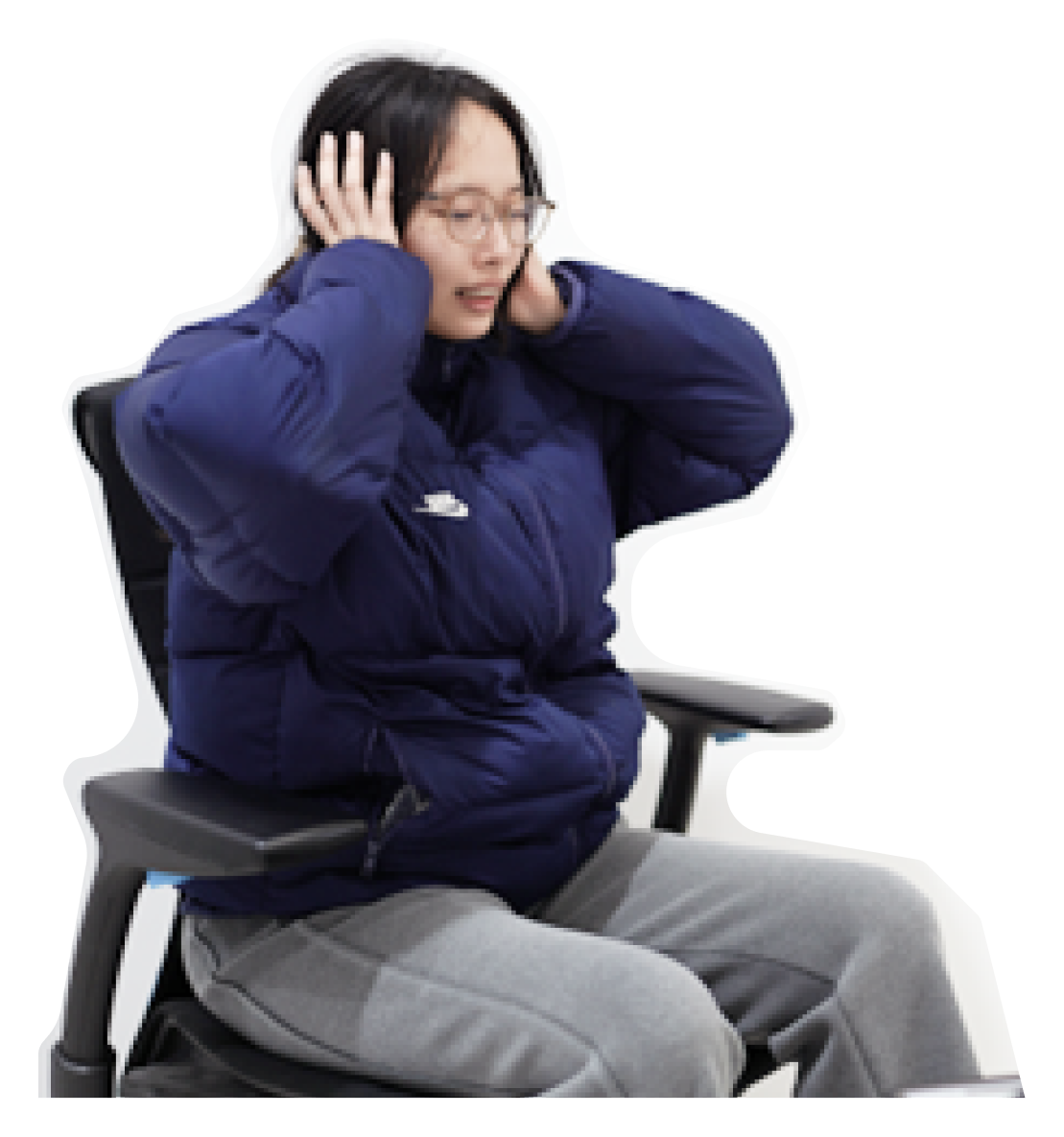
...At that time, the world around me became particularly strange, even in the familiar environment, I did not dare to act easily. ....... In my panic, I slipped.
Common Emergencies & Supplies
– Navigation challenging due to debris.
– Rely on auditory cues and protective gear.
Water & non-perishable food (72h) · First aid kit · Flashlights & batteries · Whistle to signal for help · Dust mask & protective goggles · Emergency blanket
– Smoke exacerbates disorientation.
– Memorize and practice escape routes.
Smoke mask · Fire extinguisher (small, portable) · Non-perishable snacks & water · Flashlight & batteries · Emergency blanket · Copies of important documents
– Disorientation from loud noises.
– Rely on touch and others' assistance.
Dust mask & protective goggles · First aid kit · Flashlights & batteries · Emergency whistle · Non-perishable snacks & water · Blanket
– Moving water cues to avoid areas.
– Assistance or extreme caution required.
Water & non-perishable food (72h) · Inflatable raft or life vests · Wet bags for valuables & documents · Waterproof flashlight & batteries · First aid kit
Current Supplies in Disaster Aid Kits
Myopic glasses are essential survival tools for the nearsighted during disasters, yet they are often overlooked in global disaster aid kits, which focus on food, water, and medical supplies.


Not included in any standard emergency kit globally.
Might
We
Design a temporary visual aid that works for any myopic person, deployable in seconds under panic — and belongs in every disaster kit?
Users don't need perfect vision in a disaster.
They need functional vision, fast.
Challenges & Solutions
Challenge 01
How to adapt to different prescriptions without customization?
→ Degree segmentation + liquid lens mechanism
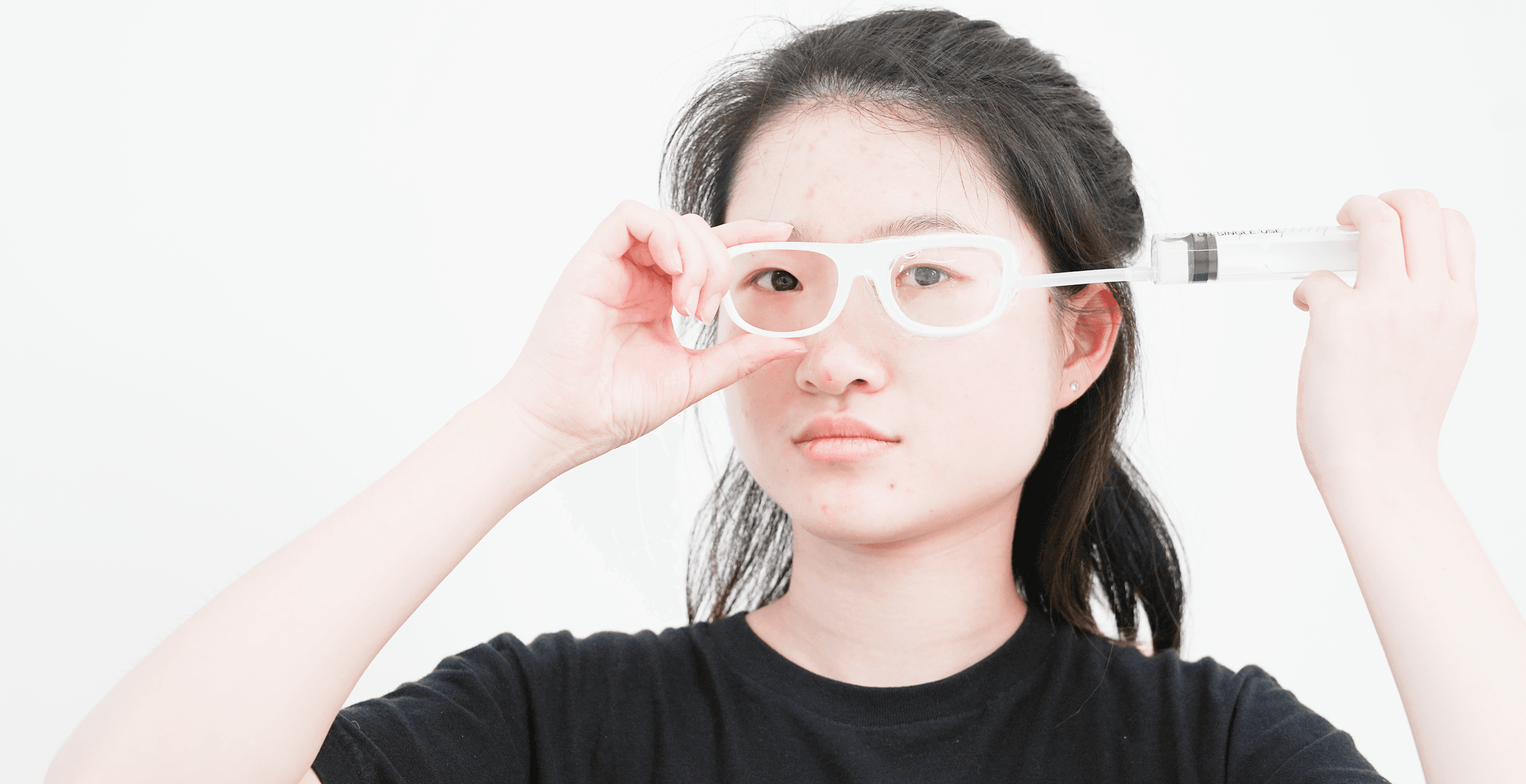
Four degree segments (300–600°) cover most myopic users. Within each segment, a liquid lens allows fine adjustment — varying liquid volume shifts curvature without a custom prescription.
Severe Myopia (>600°)
Severe Myopia (>600°)
Limited improvement with glasses — users can rely on the highest 600° setting for temporary basic aid.
Covers Most Users (300–600°)
Covers Most Users (300–600°)
Adjustable in 100° increments, simplifying production and providing essential vision support for the vast majority of myopic users.
Mild Myopia (0–200°)
Mild Myopia (0–200°)
Vision is often sufficient for survival tasks without correction — the 300° minimum setting handles these cases if needed.
Interactive — push the plunger to inject liquid
600°
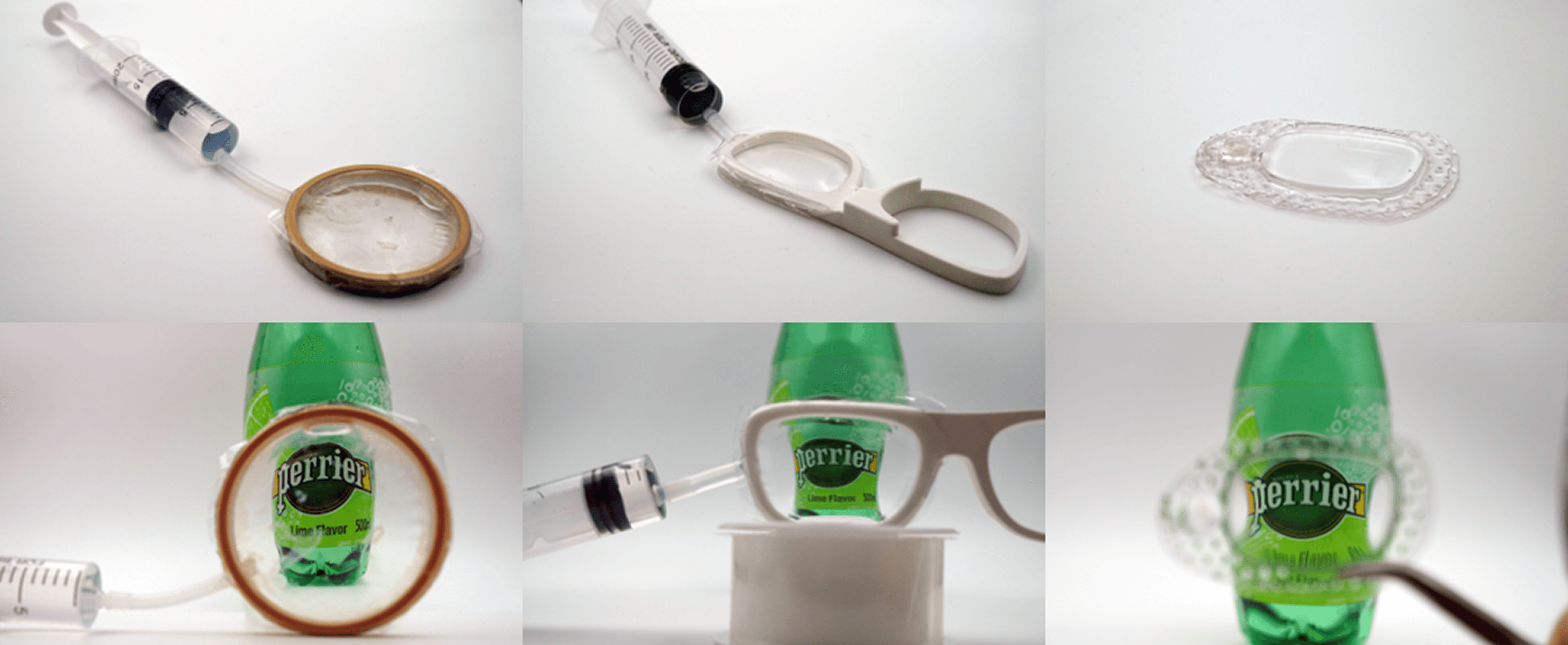
Mechanism Validation
Challenge 02
How to make diopter adjustment intuitive under stress?
→ Non-bounce-back button system
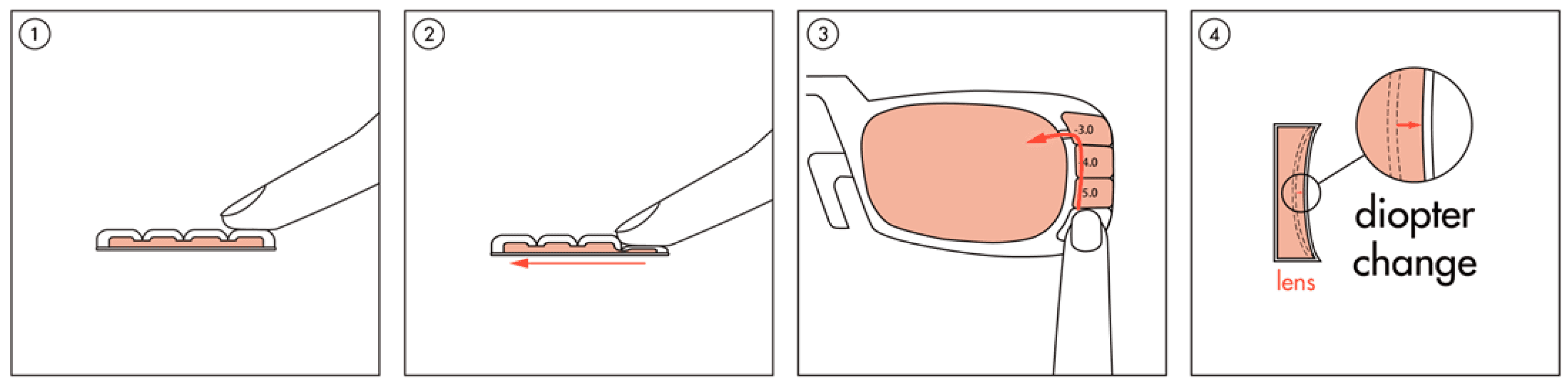
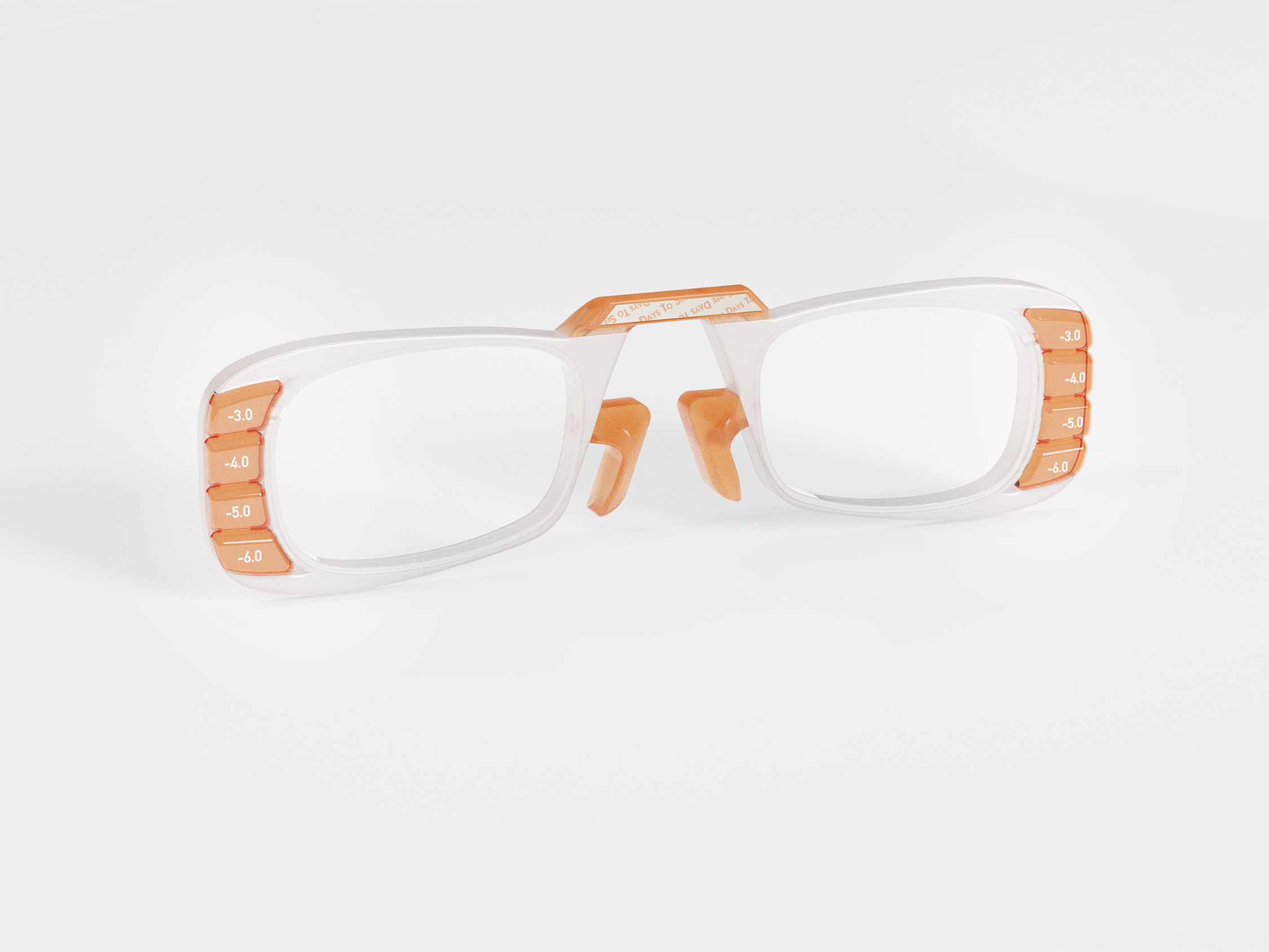
A syringe-based system was our first instinct — but testing showed it was too complex for a panicked user. Instead, we designed a button-based structure: liquid is stored in reservoirs on both sides of the frame and injected into the lens by pressing the button. Crucially, the button doesn't spring back, meaning each press is a one-way ratchet toward the correct setting. No reverse action, no fine motor skill required.
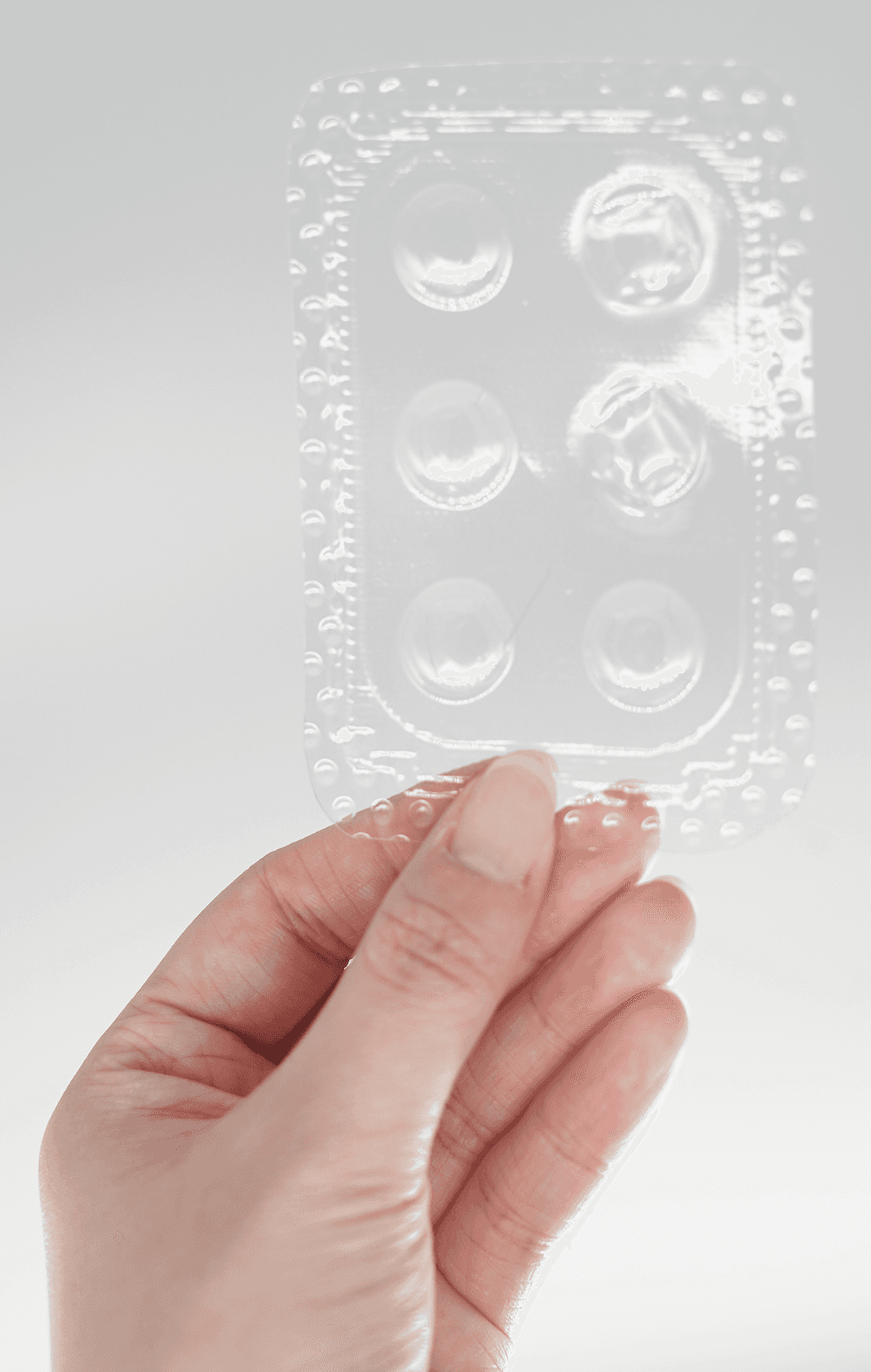
Adjustment Guide
Challenge 03
How to make them fit any face shape, safely?
→ Mirrorless leg + nose clip + medical-grade bio-glue
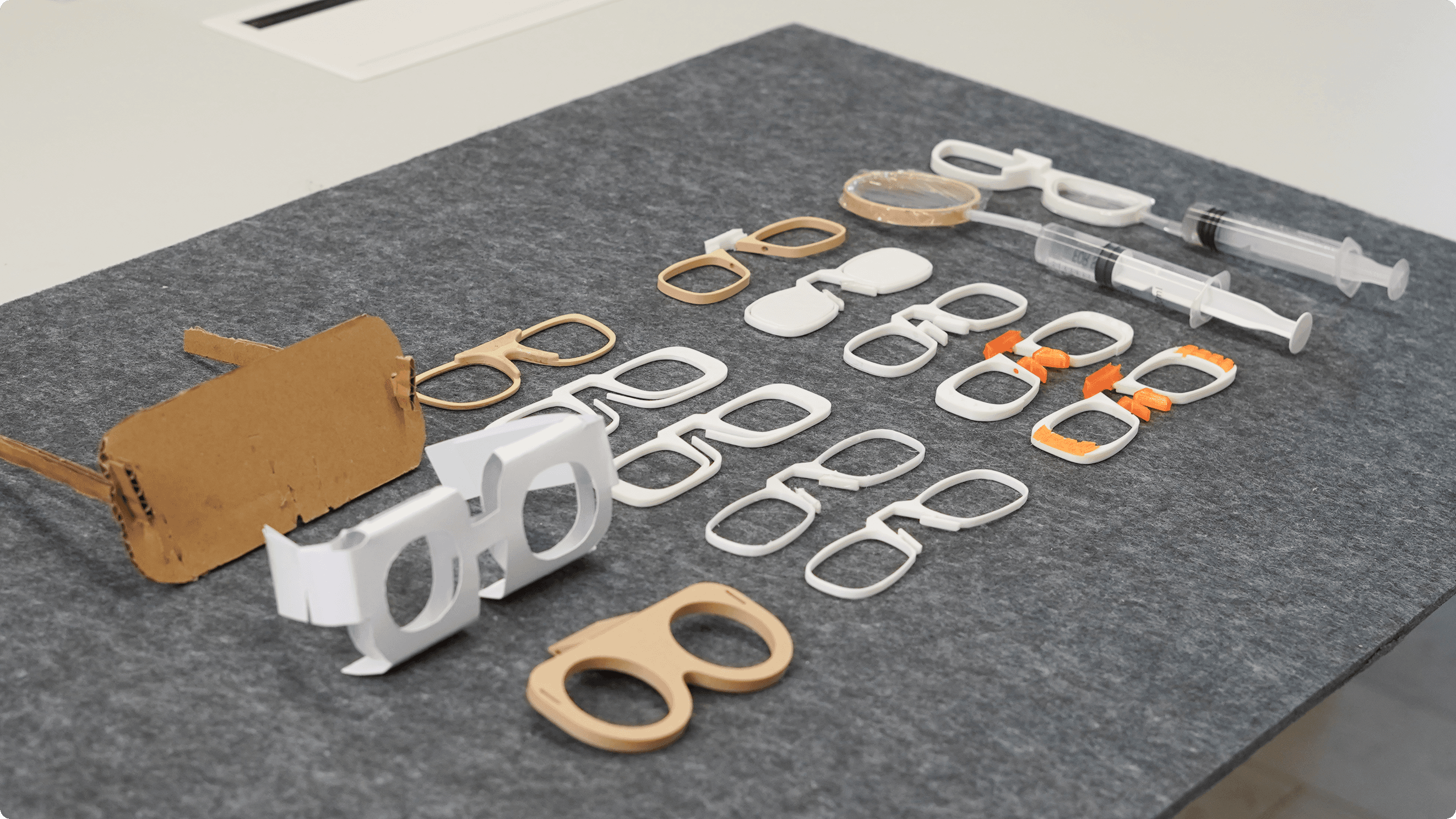
Standard ear hooks fail across diverse head sizes and hair types. We iterated through 15+ structural approaches, converging on a nose clip with medical-grade bio-glue — skin-safe, secure under movement, no fitting required.
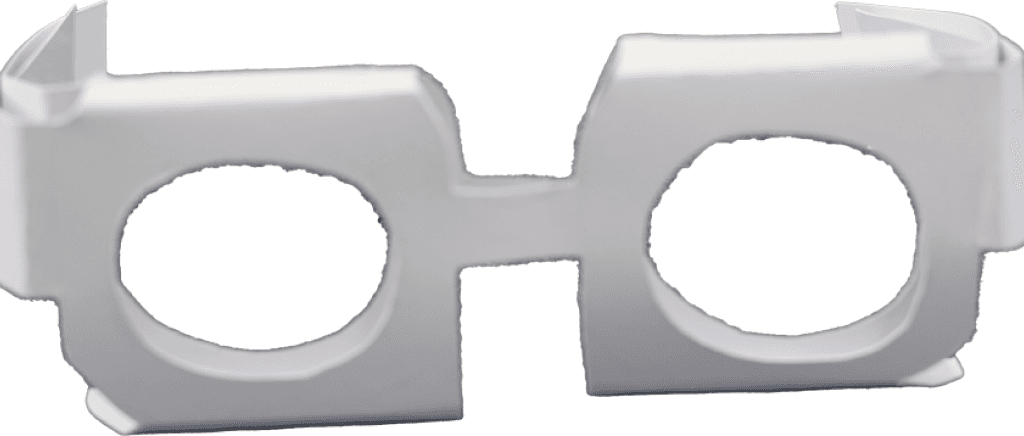
Traditional Legs
- Fail to accommodate diverse facial features.
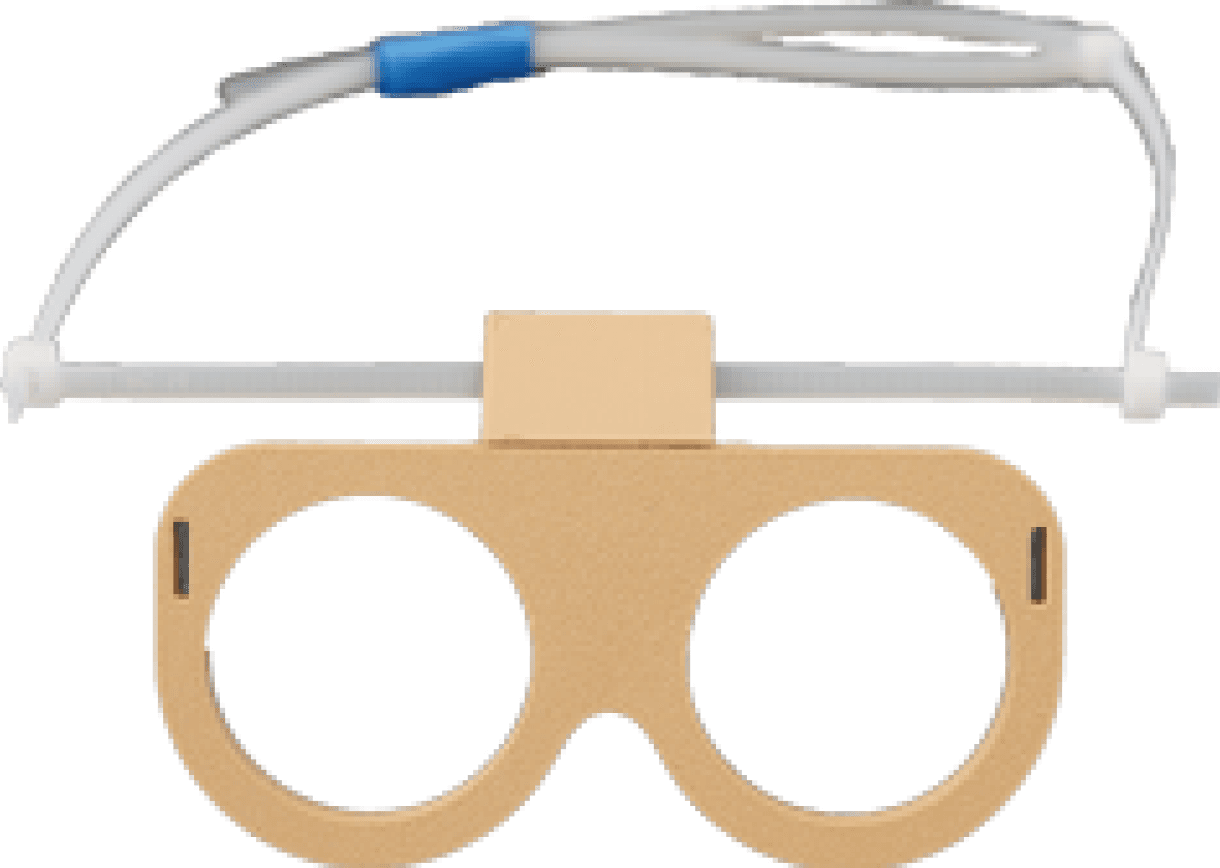
Headband Fixation
- Adjustable for diverse facial features.
- Lacks stability and size flexibility.
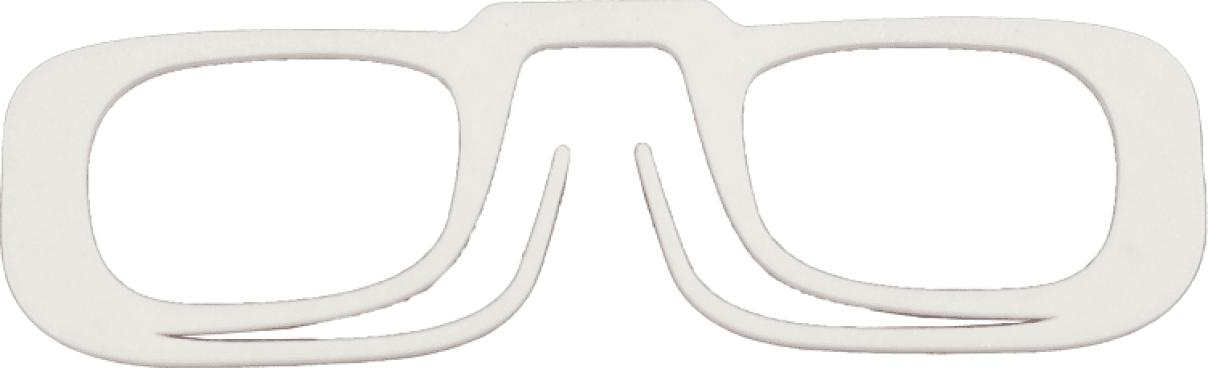
Clip Fixation
- Easy to wear.
- Unstable for longtime use.
Improved Nose Clip + Bio-Glue
- Combines stability with convenience.
- Stable for longtime use.
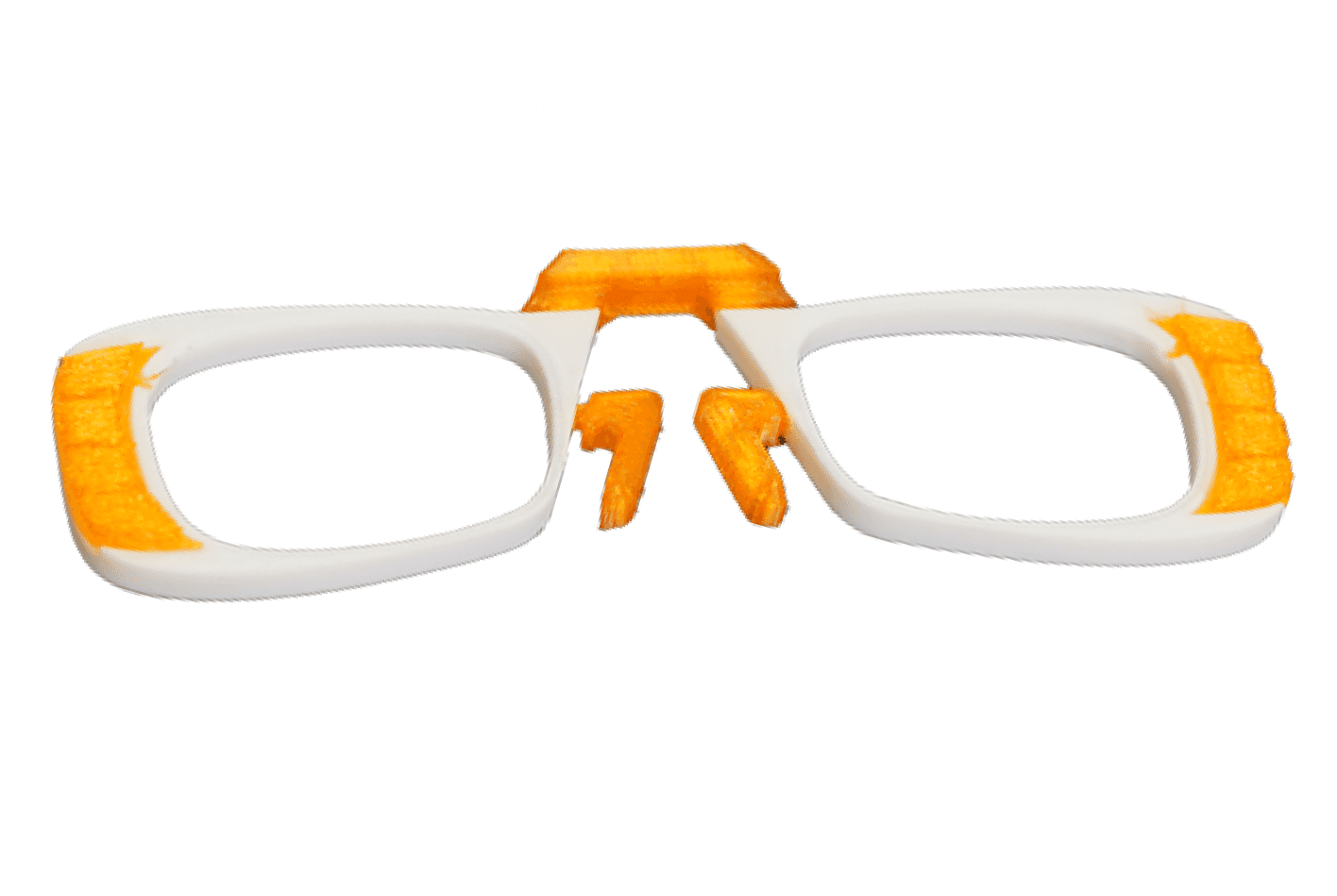
All Iterations
Wear Testing

Challenge 04
How to make them mass-producible and distribute at scale?
→ Flat packaging + silicone oil material + kit-compatible design
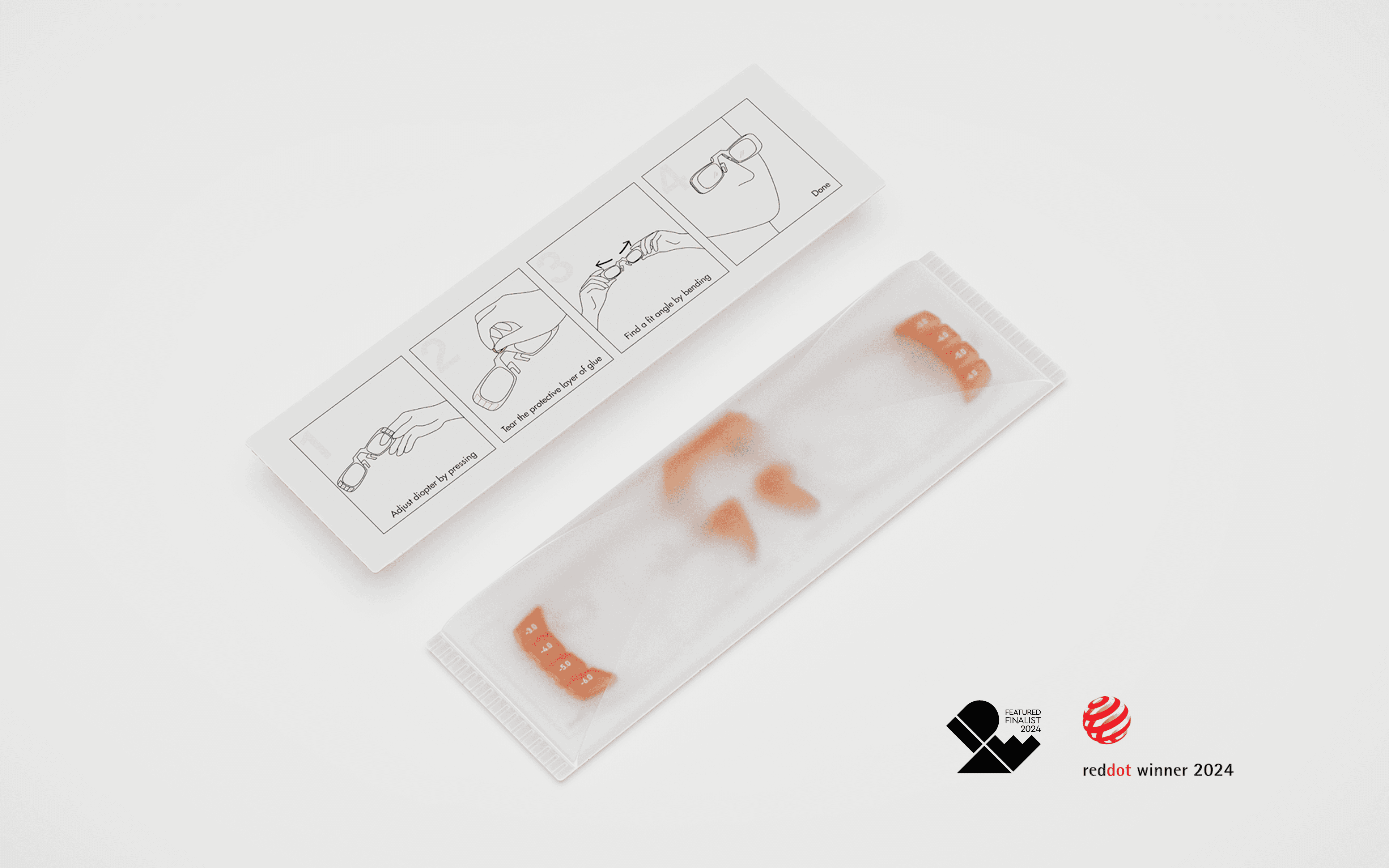
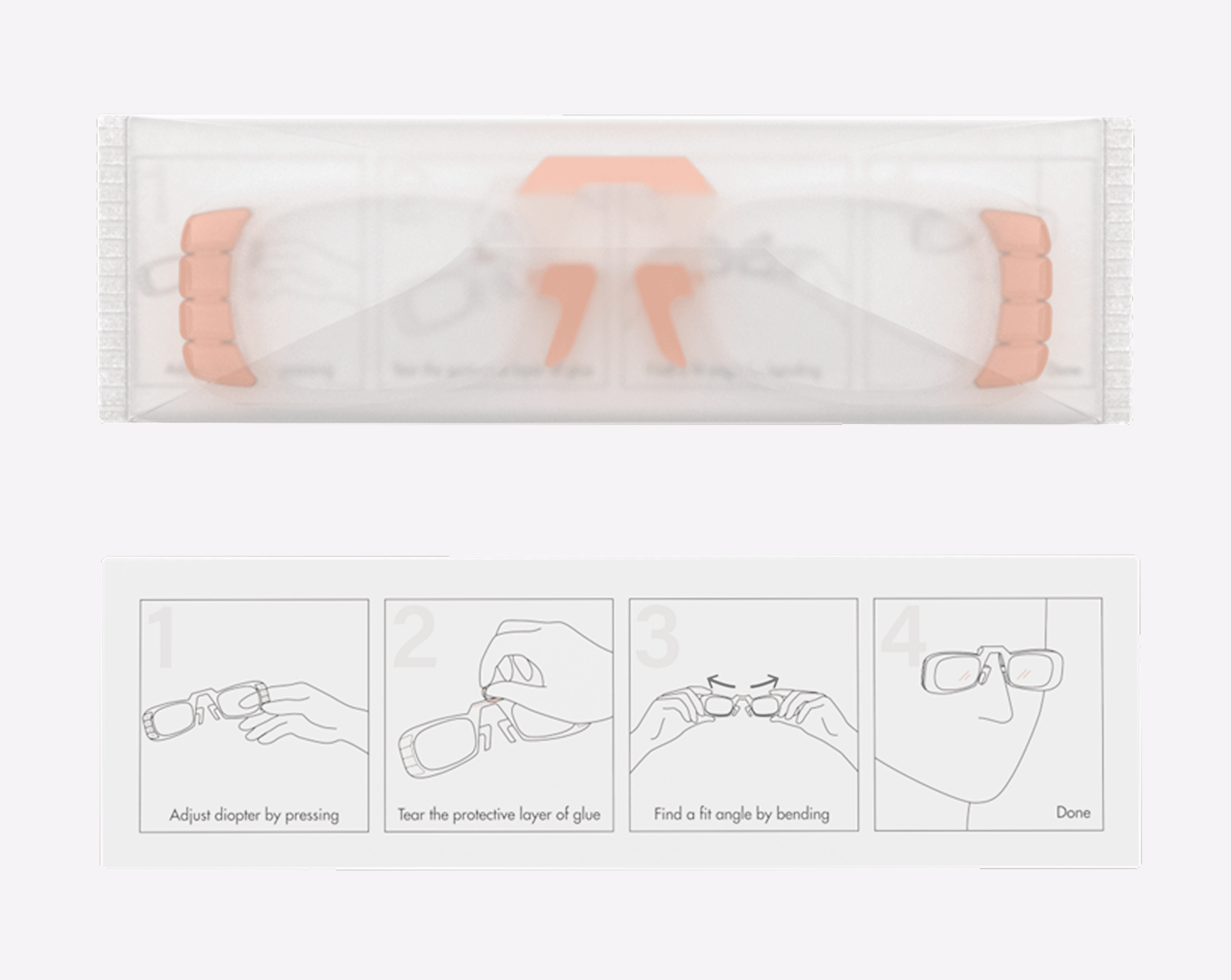
The final product is packaged flat — similar in profile to a wound dressing — making it compatible with standard emergency kit formats. Silicone oil as the lens medium offers a high refractive index, stability, durability, and non-toxicity. The unit cost is kept low enough to justify including it as a consumable in mass-distributed disaster kits.
Material & Packaging :
Cost-Effective and Safe Design
Packaging: Efficient and Compatible
- Flat design for easy storage and portability.
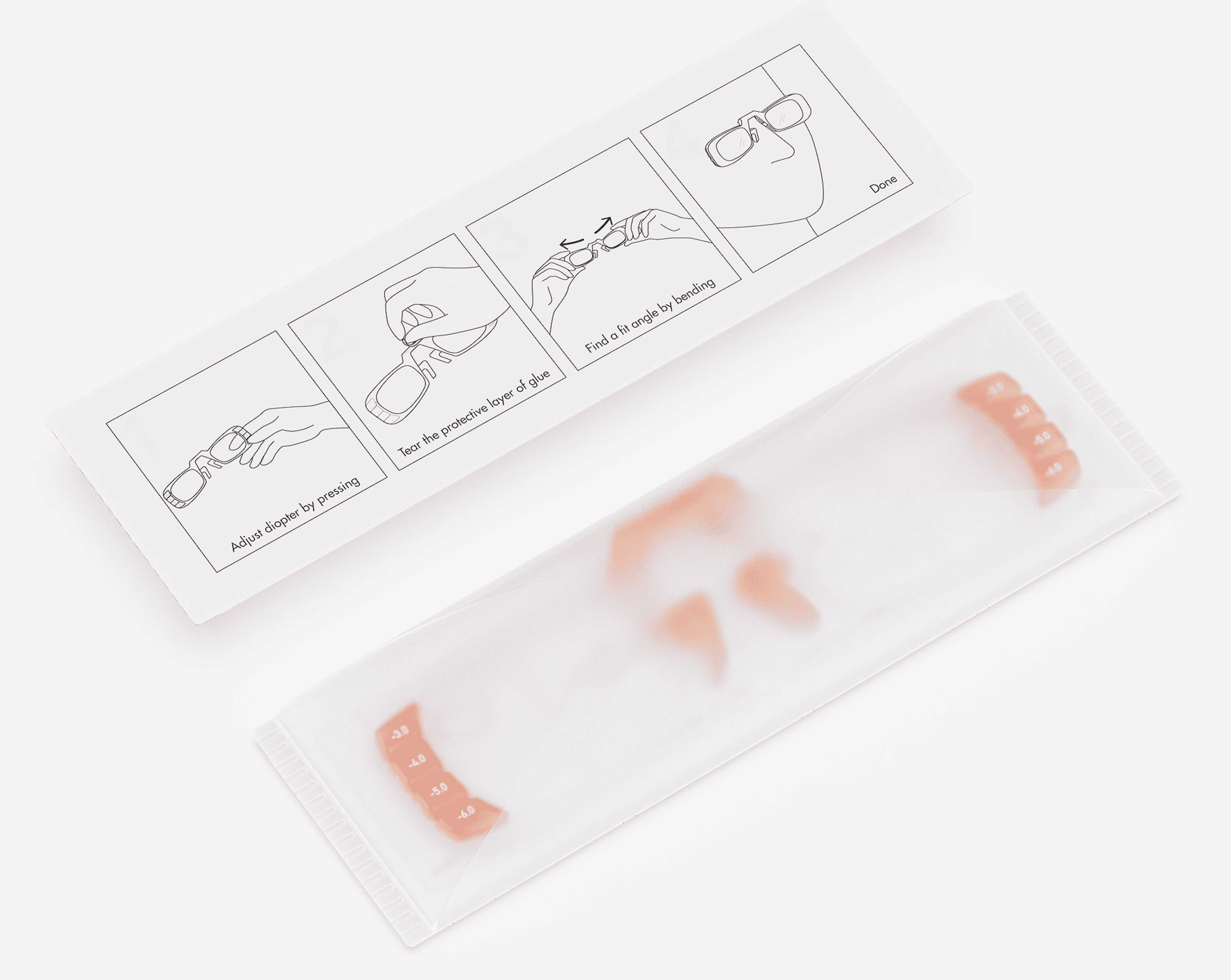
- Simple, clear usage instructions on the packaging.
- Compatible with other emergency resource equipment.
Material: Safety and Stability
- Liquid-based adjustment reduces mass production costs.
- Silicone oil offers high refractive index, stability, durability, and non-toxicity.
- Good light transmission and resistant to deterioration or evaporation.
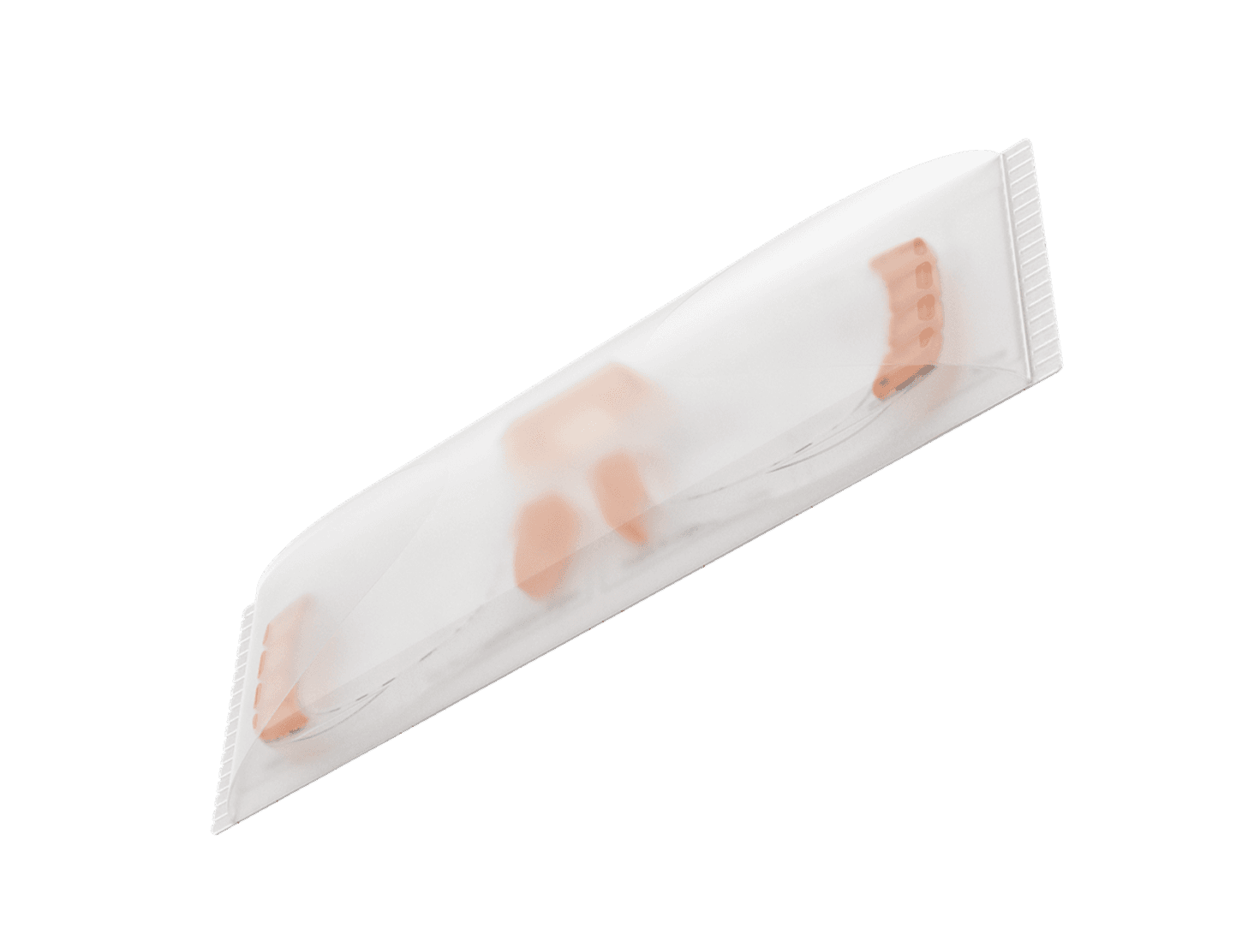
Product Package Views
Final Design
Simple enough for your worst day
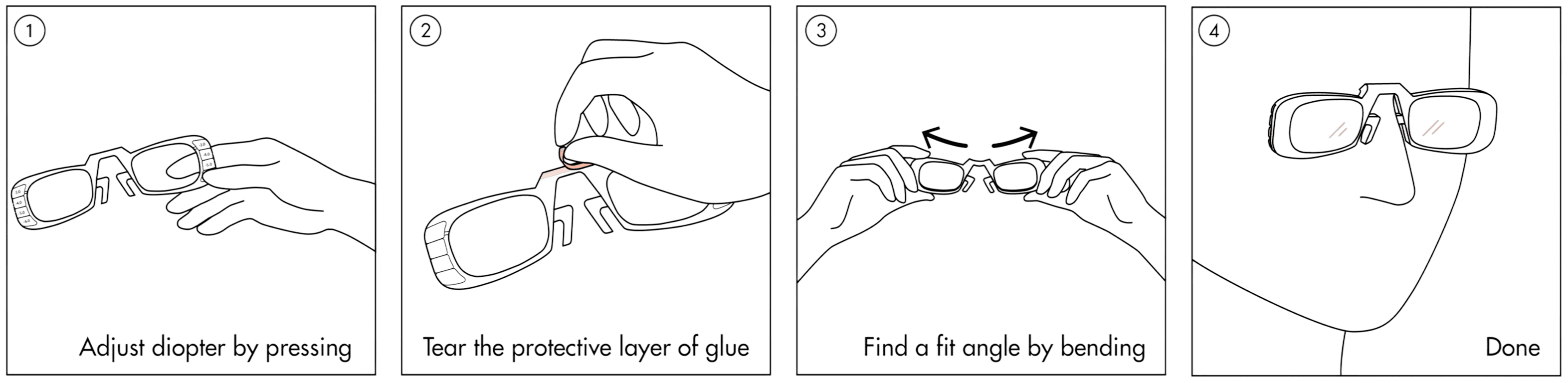
The final 3D2C glasses are frameless, flat-packed, and deployable in four steps that require no prior knowledge or training. The liquid-filled soft lenses, elastic connections, and medical bio-glue work together to form a product that feels more like a first-aid supply than an optical device — which is exactly the point.
Exploded View
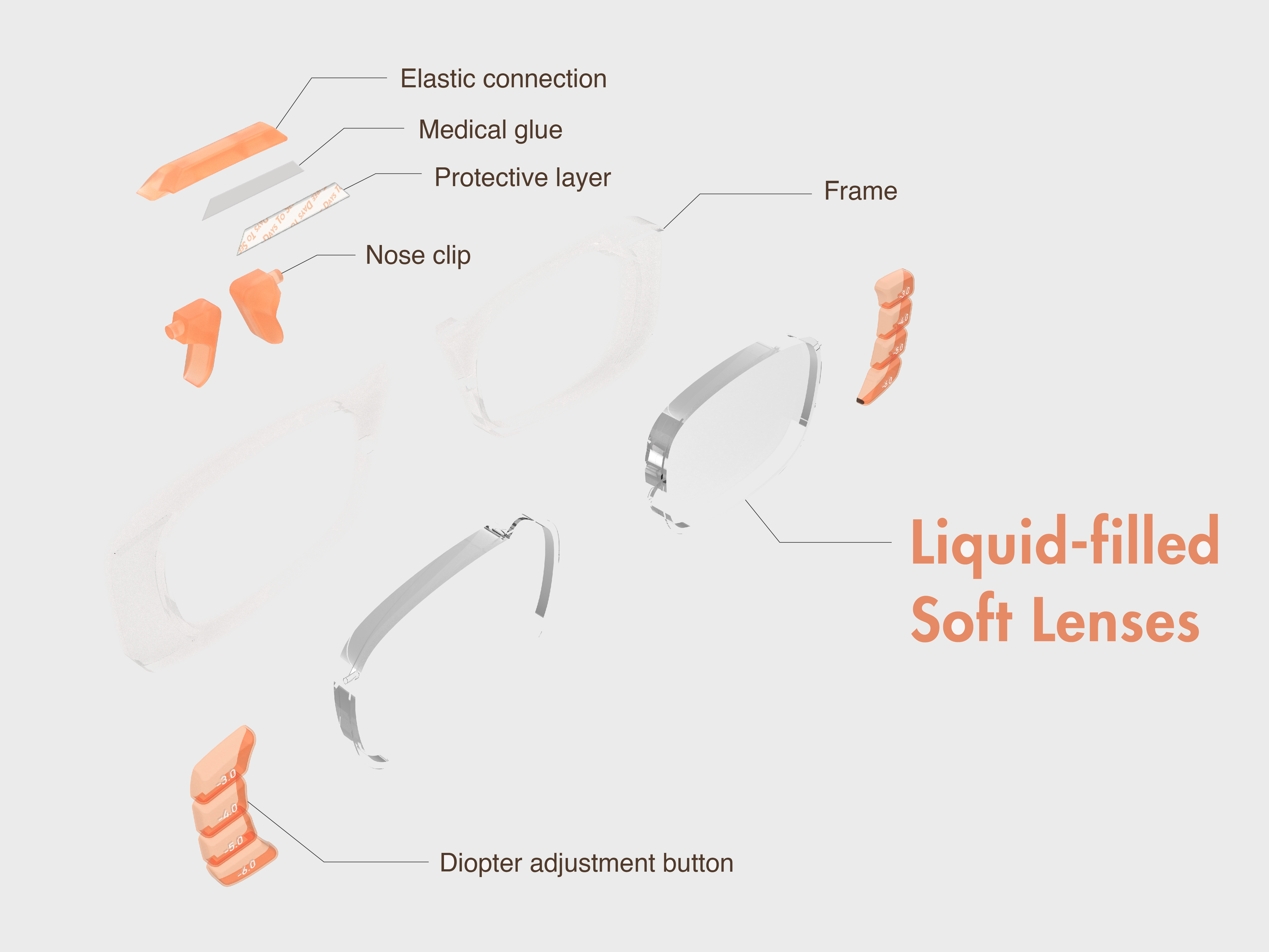
Product Components
Elastic connection
Joins the two frame halves; allows the nose-bridge width to flex for different face widths without additional adjustment.
Medical-grade bio-glue
Skin-safe adhesive that secures the frame to the nose bridge — no ear hooks, no fitting required.
Protective layer
Peel-off film that keeps the glue sterile before use. Simply tear to activate before wearing.
Frame structure
Lightweight plastic shell housing the liquid reservoirs and button-press injection mechanism on each side.
Nose clip
Bendable metal strip that conforms to the nose contour, distributing holding force evenly across the bridge.
Liquid-filled soft lenses
Flexible lenses filled with silicone oil. Pressing the side button injects more liquid, increasing optical power.
How to use — 4 steps
In Use
Life after 3D2C
When glasses aren't an option, 3D2C becomes the difference between disorientation and agency. The storyboard follows Emily — a 28-year-old software engineer in San Francisco with up to 500° myopia — through the moments after an earthquake, from locating the kit to walking out with clear vision. No prescription, no fitting, no training needed.
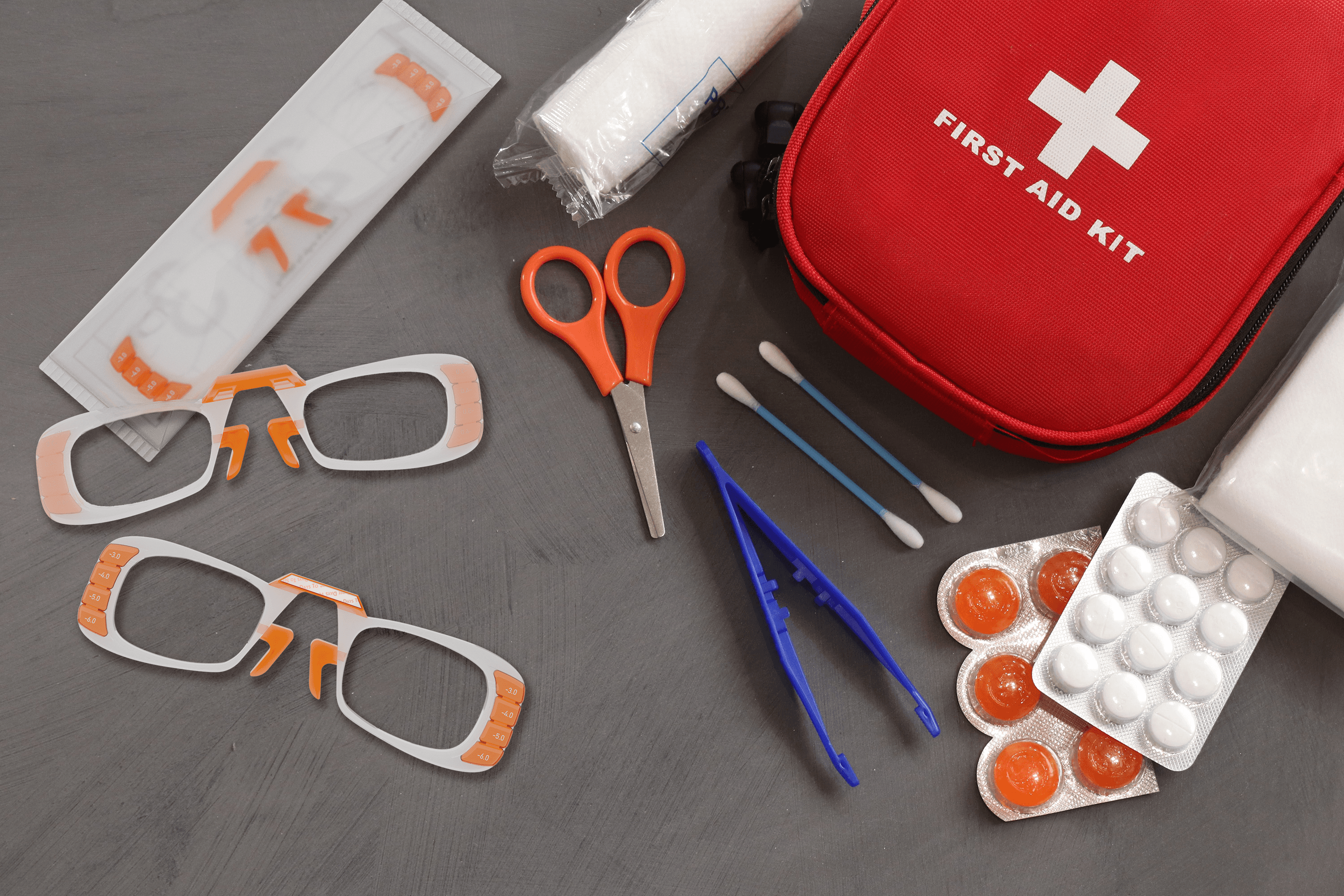
3D2C glasses stored inside a standard emergency kit — ready to use without prior setup.
User Persona
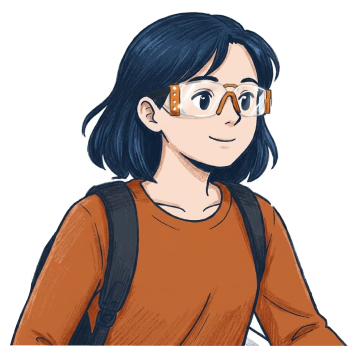
Emily is a software engineer in San Francisco. She can't read a sign across the street without her glasses — never could. She has an emergency kit under her bed. She checked it twice. She never thought to check if she could actually see during an emergency.
Emily's earthquake escape with 3D2C ↓
Storyboard
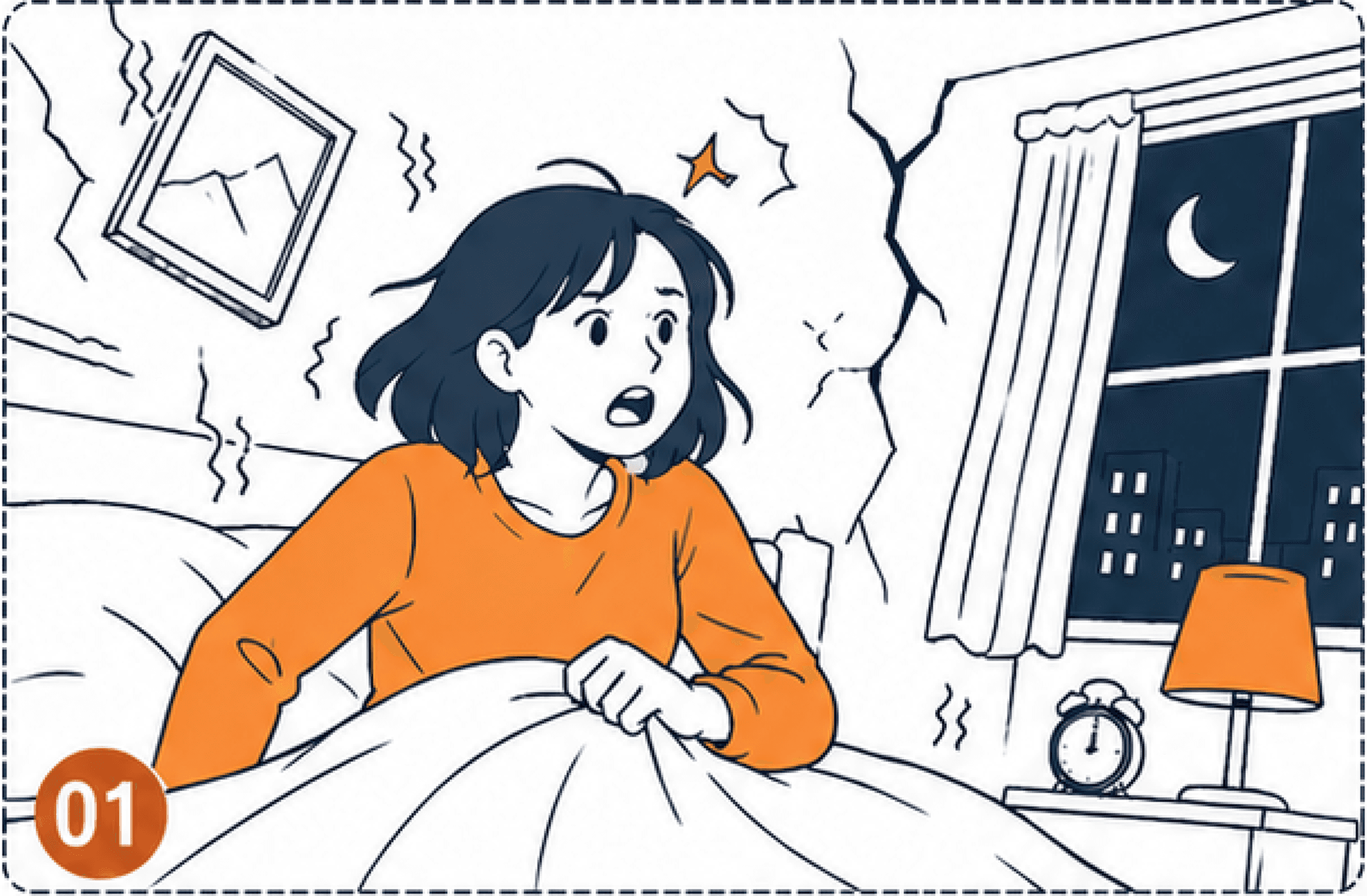
A powerful earthquake hits at 3am.
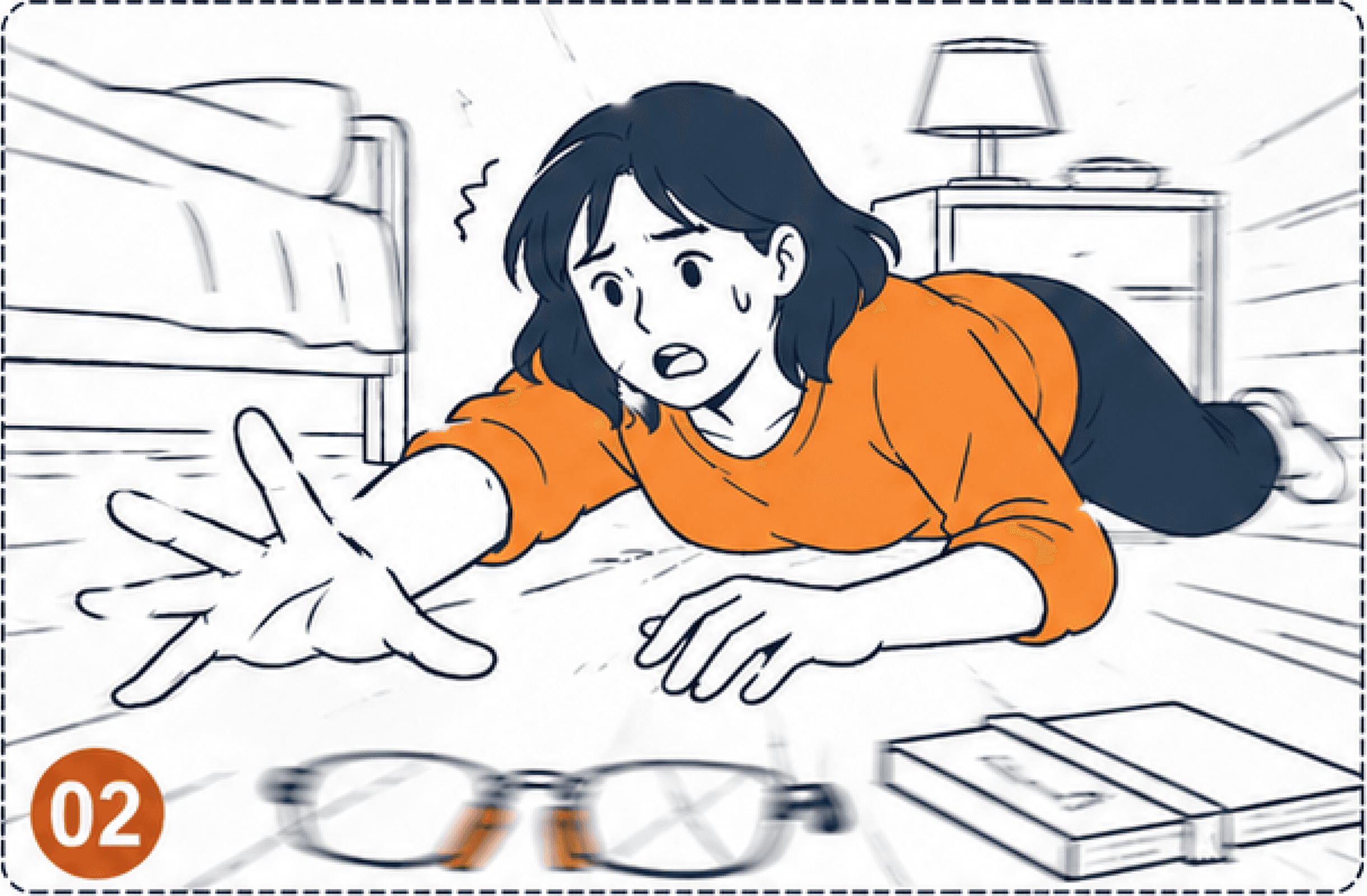
Everything is a blur without her glasses.
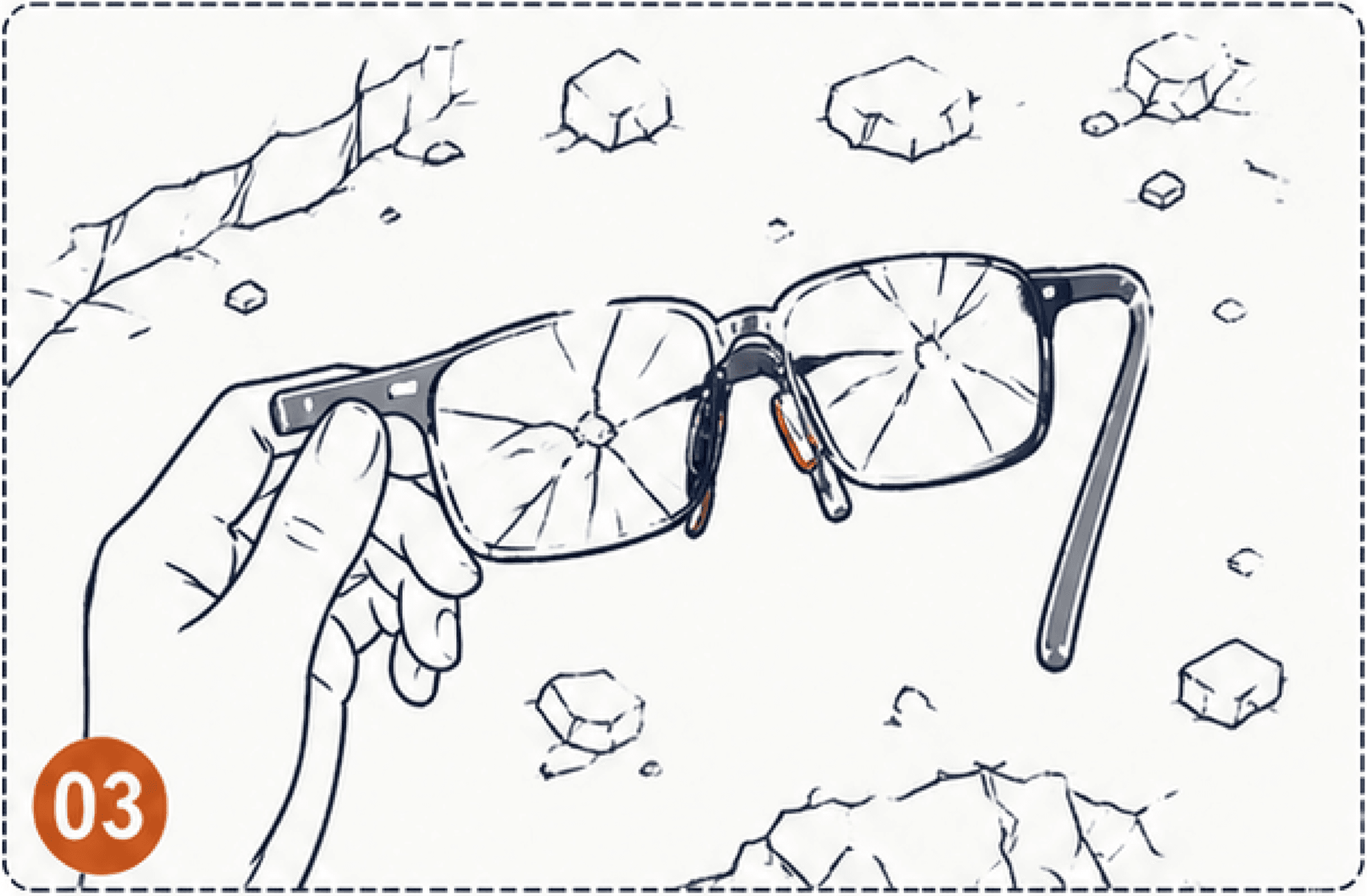
She finds them — already broken.
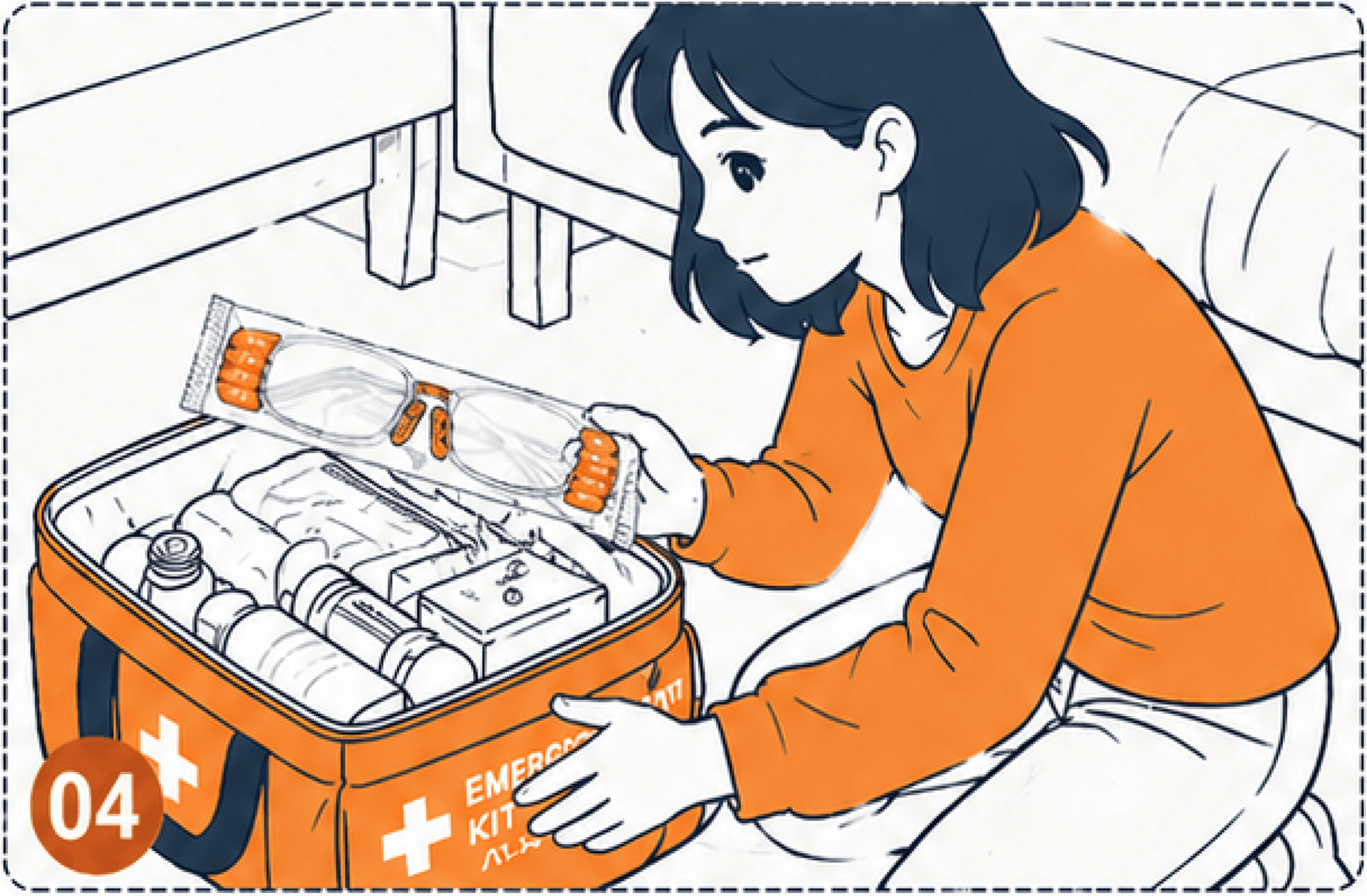
Her emergency bag has one more thing inside.
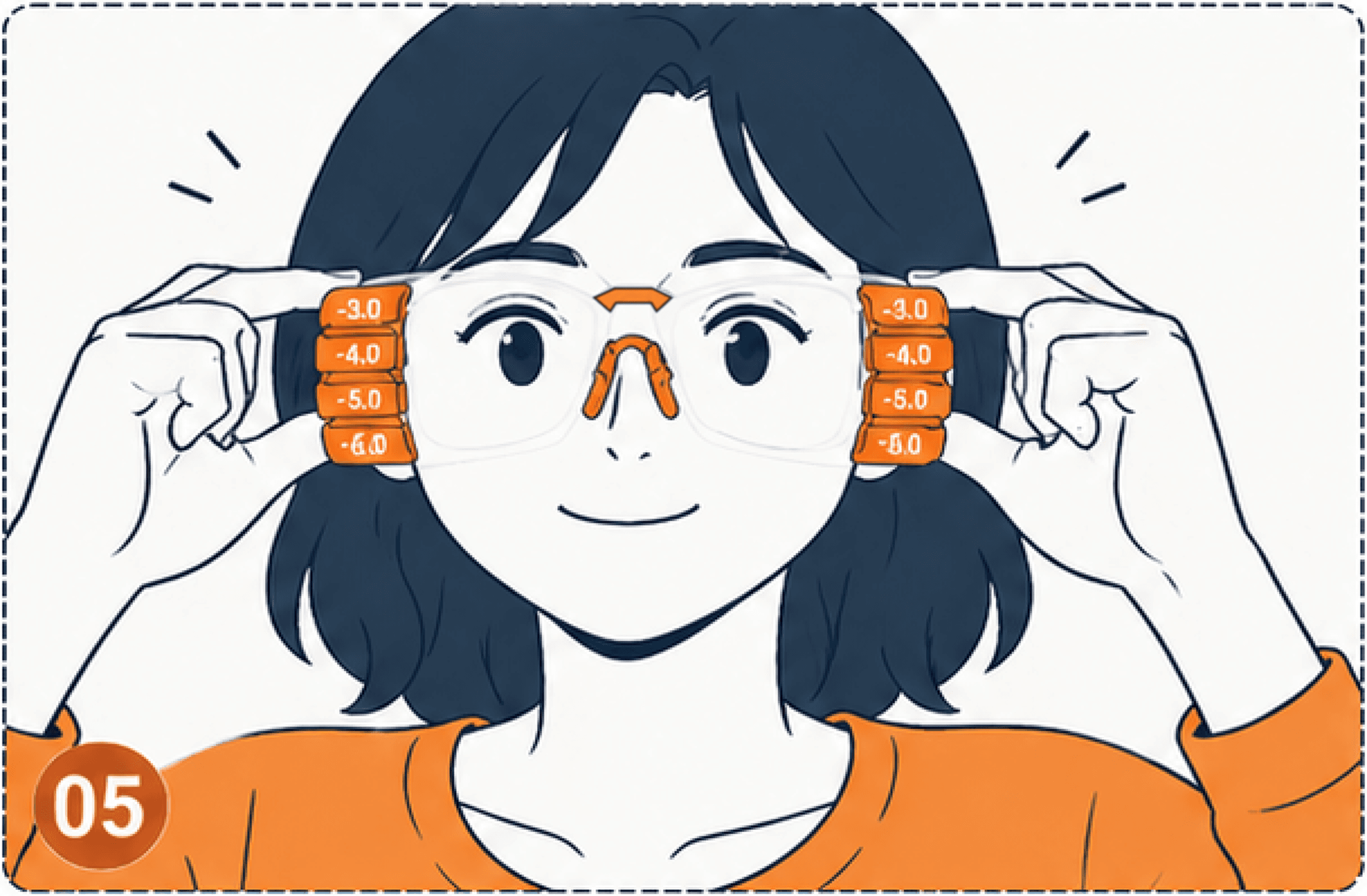
She adjusts the lens. Vision returns.
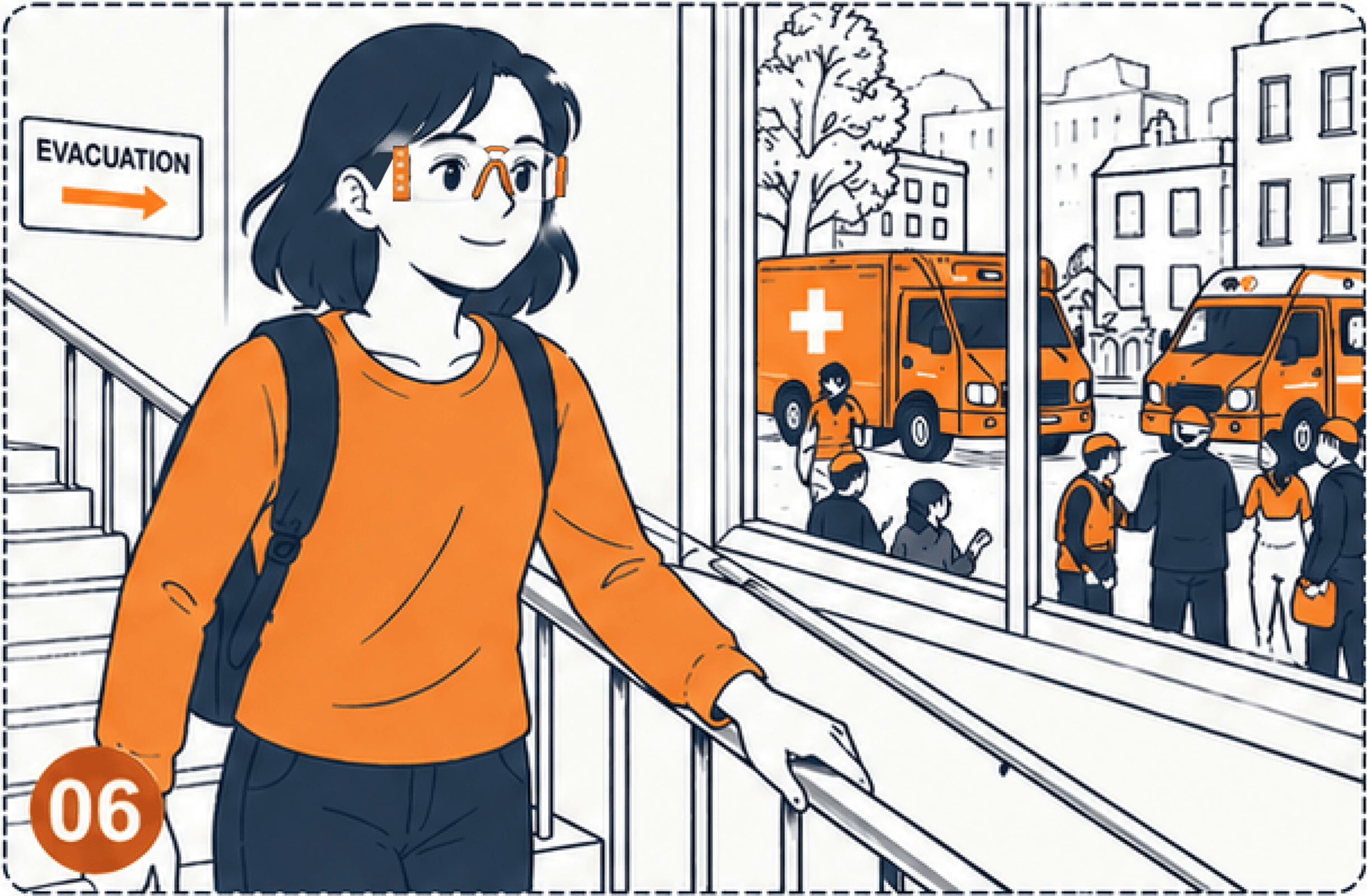
Twelve floors down. She makes it out.
Making Process
15+ prototypes across 3 fabrication methods
Getting to the final design required a fast, iterative loop between digital modeling and physical making. We tested mechanisms with water and mineral water bottles before committing to silicone oil. Each frame iteration exposed a new failure mode — and a better answer.
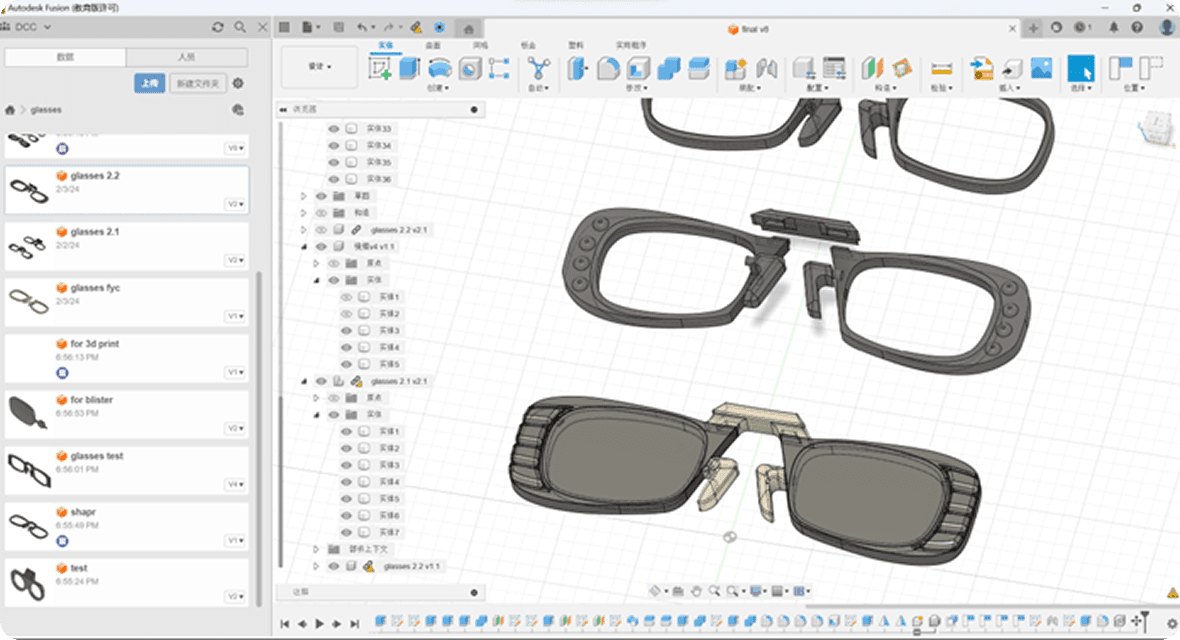 3D Modeling
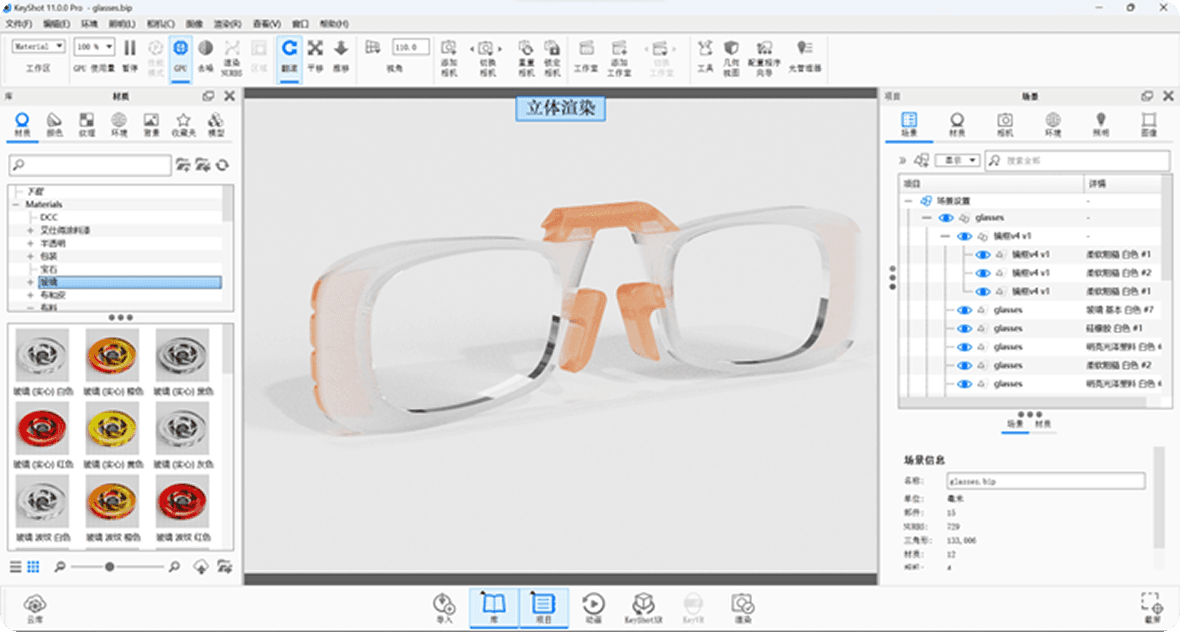 Rendering
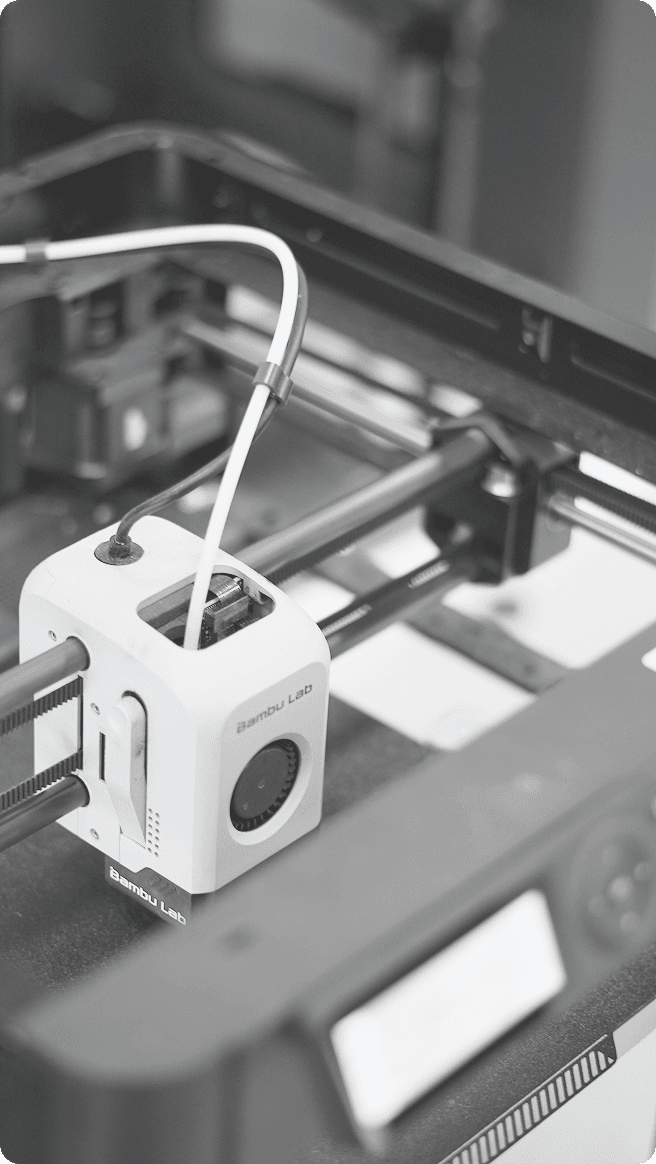 3D Printing
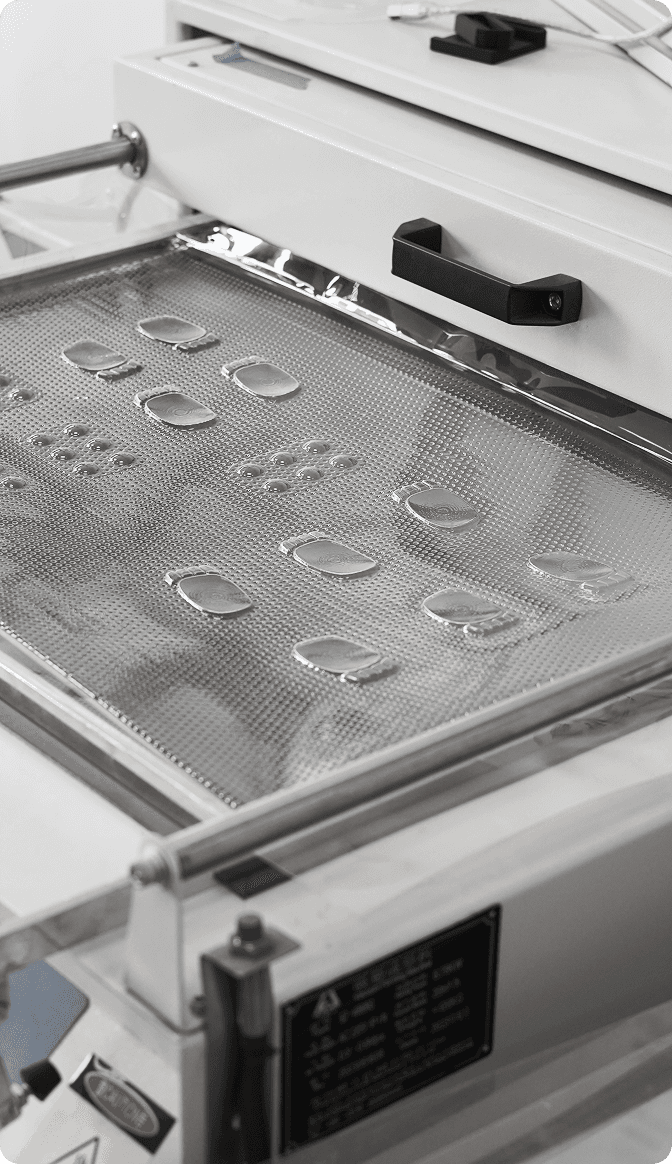 Moulding Plastics
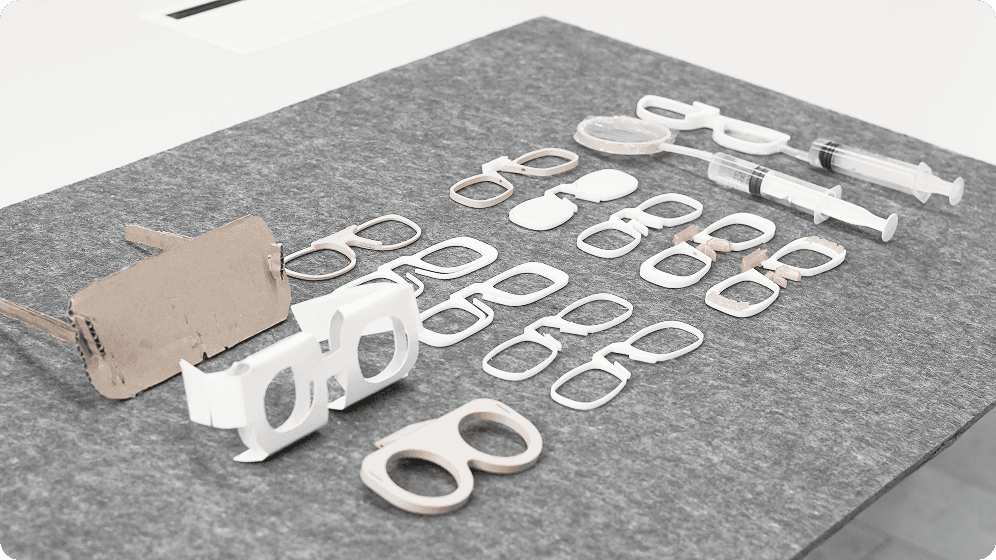 Prototype Iteration
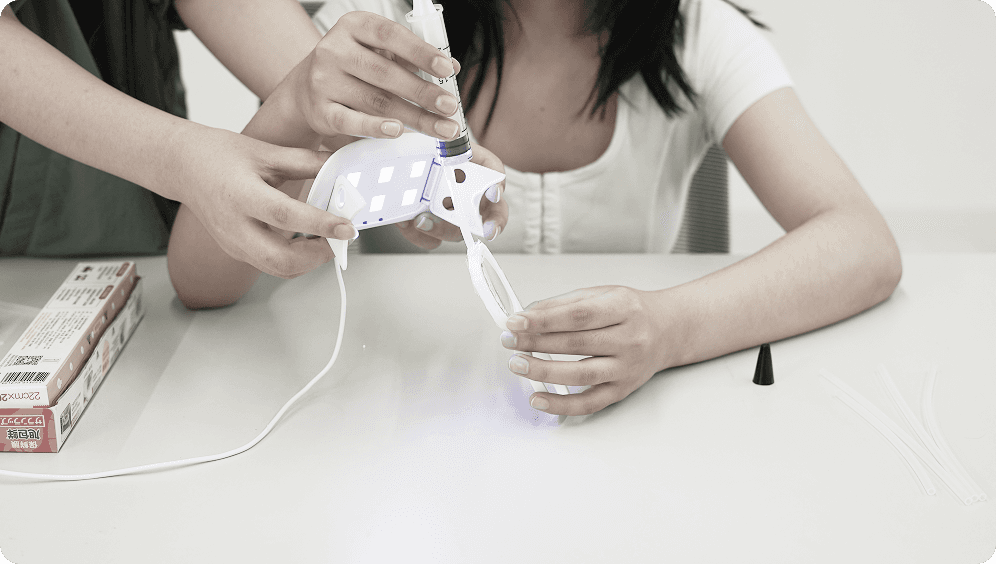 Prototype Making
Feedback & Reflection
Feedback
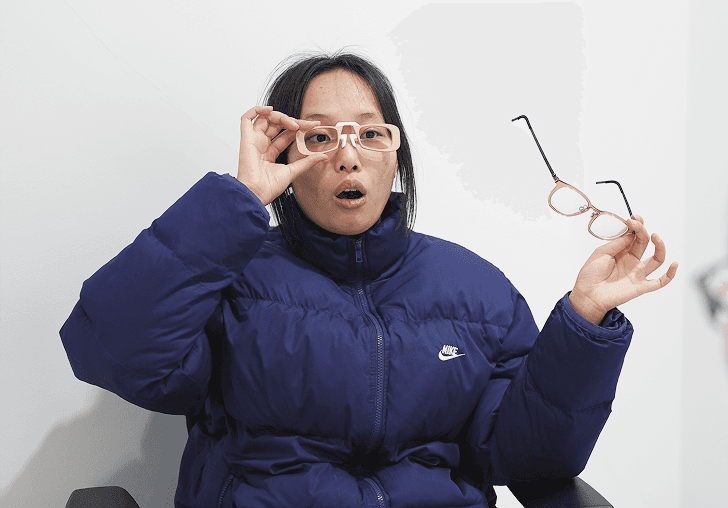
I've never imagined such a simple design could solve my urgent need for vision during emergencies. Brilliant idea!
— Usability testing participant
Recognition

Red Dot Design Award 2024
Winner · Design Concept
IDEA 2024
Finalist · Student Design
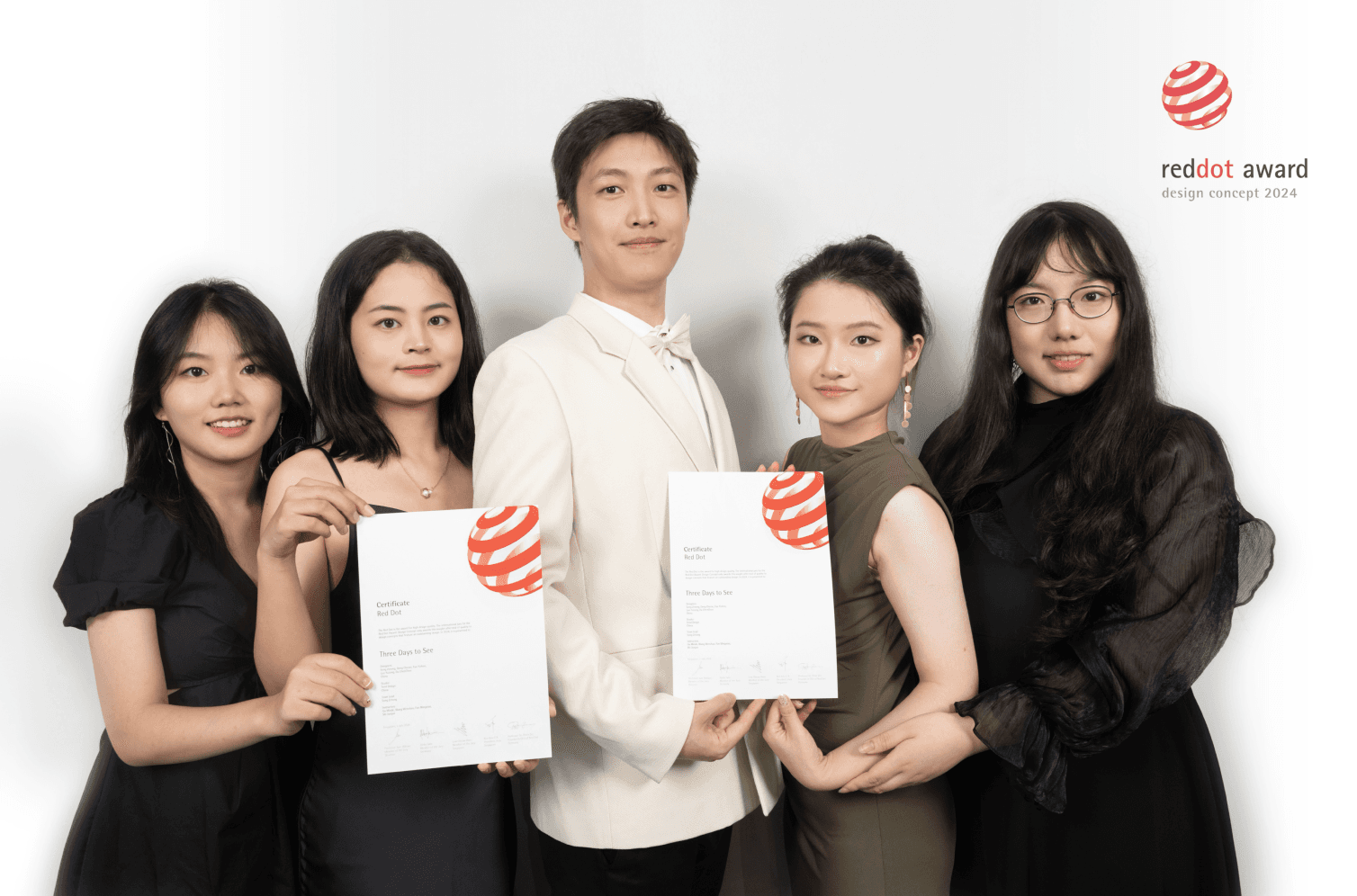
Red Dot Award 2024, Singapore
Reflection
Niche problems are real problems.
We almost dropped this direction because it felt too narrow. But 1.1 billion people have myopia, and none of the standard emergency kits address it. Edge cases aren't always small.
Panic is a design constraint.
A lot of our early ideas were clever. None of them survived the question: would you actually use this at 3am, scared, in the dark? We cut a lot. What was left was simpler than we expected.
The award was nice. One moment mattered more.
A classmate put on the prototype and said she never thought anyone would design this for her. That one sentence told us more than any jury could.
I started this project because I couldn't see without my glasses. I finished it knowing that design can close gaps that policy hasn't noticed yet.